
 REKA Otomatik Yapı Teknolojileri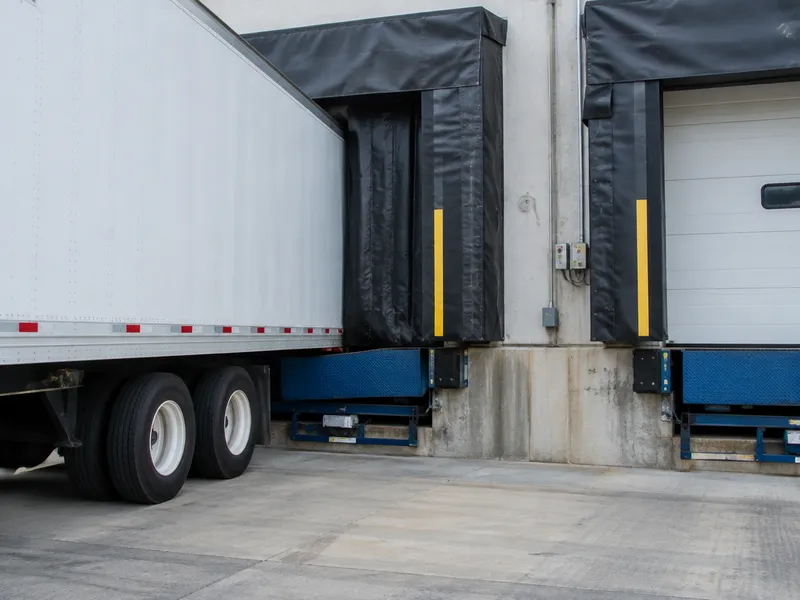
What is a dock shelter?
A dock shelter is a flexible structure mounted around the outside of a warehouse loading door that surrounds the body of the docked vehicle, closing the gap between the vehicle and the building. This keeps contact with the outside to a minimum during loading and unloading. At a loading bay, the following equipment usually works together:
- Mechanical or inflatable dock shelter: Mechanical shelters surround the vehicle with a frame and curtains; inflatable shelters use air cushions inflated by a fan.
- Dock leveller: A hydraulic platform that bridges the height difference between the vehicle bed and the warehouse floor.
- Industrial sectional door: An insulated, motorised door that closes off the loading bay.
- Bumpers and vehicle guidance equipment: Ensure the vehicle docks safely against the building.
A loading bay should be considered as a whole. If the shelter, leveller and door are not chosen to work together, either a gap is left between the vehicle body and the shelter, or the leveller obstructs the door's movement. That is why we plan all the equipment in a single project so that everything is compatible.
Where they are used in North Cyprus
Warehouses in the Nicosia (Lefkoşa) industrial zone and around Haspolat, logistics facilities near Famagusta (Gazimağusa) port, citrus packing and agricultural produce stores in Güzelyurt, and supermarket chain distribution centres are where dock shelters are needed most. In the Cypriot summer heat an open loading door can break the cold chain, while in winter rain can soak the goods. In dusty inland areas a shelter also helps keep products clean.
Improvements at the loading bay affect not only product safety but also working conditions for staff. A loading bay where wind and rain can't get in and the height difference is bridged by a leveller reduces the risk of workplace accidents and shortens loading and unloading times.
What to consider when choosing
- Vehicle types: The types of vehicles docking at your site determine the size and type of shelter; if different vehicles arrive, a flexible solution is needed.
- Type of goods: For cold chain products, sealing is the priority; inflatable shelters stand out here.
- Building façade: The wall the shelter will be mounted on and the door opening are inspected during the survey.
- Need for a dock leveller: If the vehicle bed and floor are not at the same level, a leveller should be planned.
- Door integration: The sectional door, leveller and shelter working together can be supported with safety interlocks.
- Power cuts: How the door and inflatable shelter behave during a Kıb-Tek power cut should be decided in advance.
Options and accessories
- Mechanical, inflatable or curtain-type shelter options
- Hydraulic or mechanical dock levellers
- Motorised industrial sectional doors
- Docking bumpers and vehicle guide lines
- Dock lights and traffic lights
For internal passages in your cold chain stores see our cold room door solutions, and for site entrance security our barriers and number plate recognition systems.
With inflatable shelters, the fan unit's power connection and control are key; with mechanical shelters, the strength of the frame matters most. Because vehicles bumping into the shelter when docking can tear the curtains over time, docking bumpers and guide lines help extend the shelter's life.
Installation process
- Site survey: We inspect the loading points, the vehicle docking area and the building façade on site.
- Quote: We provide a written quote explaining the shelter, leveller and door options.
- Installation: We plan the work bay by bay so as not to disrupt your site's shipping schedule.
- Handover: We test with a docked vehicle and give your staff usage and safety information.
For an outline of our workflow, see the how it works page.
Before installation, we review together the body height and width of the vehicles that most often use the loading points. This information directly determines the shelter size, the leveller position and the bumper height; proper planning avoids later corrections.
Maintenance and warranty
Curtain wear on dock shelters, the condition of the fan and air cushions on inflatable shelters, the hydraulic system on levellers, and spring and motor checks on industrial doors are all part of periodic maintenance. For the systems we install: 3-year warranty; if periodic maintenance is carried out without interruption, the warranty can be extended to up to 5 years. We support you with our 24/7 breakdown service so your shipments don't stop.
Carrying out maintenance before busy shipping periods prevents a loading point from going out of service mid-season. For businesses with seasonal peaks, such as citrus and agricultural produce, we recommend planning the maintenance schedule around harvest and shipping periods.
Why REKA?
- Over 20 years of experience with industrial doors and automation
- Door, leveller and shelter planned from a single source
- We work with all brands and source equipment from Turkey
- Free site survey across North Cyprus
Call us on +90 539 102 13 13 for your facility or request a free site survey.